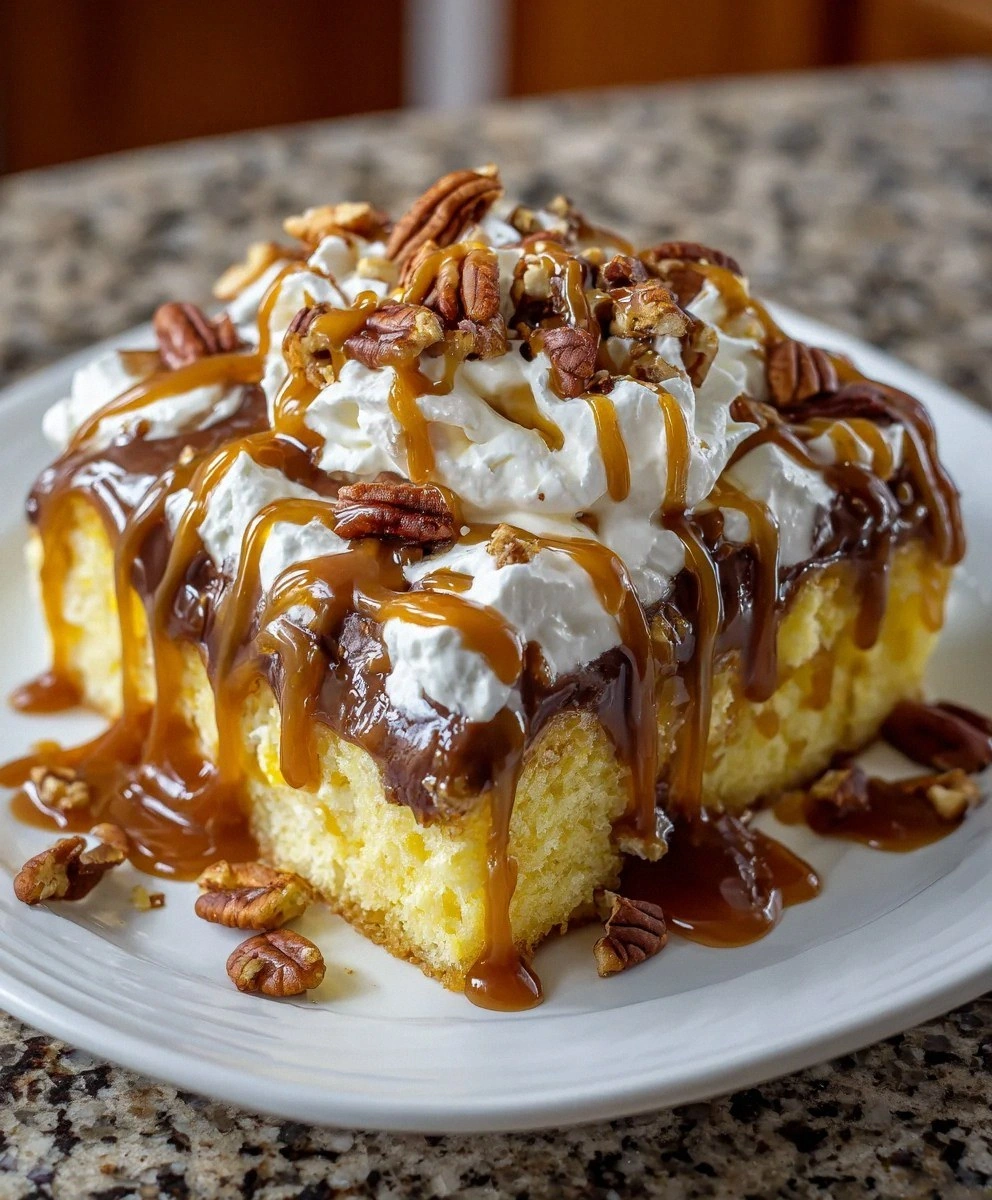
I was elbow-deep in chocolate frosting at 11:47 p.m. on a Tuesday when I realized I’d forgotten to poke the dang cake. The caramel had cooled, the pecans were toasted, and there I stood—in my ratty “Kiss the Cook” T-shirt—holding a wooden spoon like it might solve my existential crisis. You see, I’d promised my coworkers a Turtle Poke Cake that would make them weep tiny rivers of joy, and now the thing looked as flat and un-poked as a Midwestern interstate. So I did what any self-respecting dessert addict would do: I stabbed that chocolate slab like it owed me rent money, poured glossy caramel into every tunnel, and whispered sweet apologies. The next morning the pan was licked so clean you could’ve used it as a mirror. That, my friend, is the power of Turtle Poke Cake when you do it right—and today I’m handing you the keys to caramel-soaked, pecan-crunchy, chocolate-ganache glory.
Picture this: moist devil’s food cake marbled with pockets of buttery caramel, each bite punctuated by toasted pecans that snap like autumn twigs. Then imagine glossy ganache sliding across your tongue, carrying hints of espresso and vanilla, while flaky salt dances on the finish like a tiny rave. That sizzle when warm caramel hits the cake pores? Absolute perfection. I dare you to taste this and not go back for seconds—actually, thirds—while standing over the sink so nobody hears the fork clinking. I’ve seen grown accountants abandon spreadsheets mid-formula once they get a whiff of this thing cooling on the break-room counter.
Most recipes get poke cake completely wrong: they under-season the batter, use synthetic whipped topping, or—gasp—forget to toast the nuts. The result is a sad, soggy travesty that tastes like refrigerated regret. This version flips the script with brown-butter cake batter, espresso-laced ganache, and a triple-hit of toasted pecans: stirred into the filling, pressed onto the sides, and candied on top for shattery drama. I’ll be honest—I ate half the batch before anyone else got to try it, and I have zero remorse. If you’ve ever struggled with dry poke cakes, watery caramel, or nuts that go soft overnight, you’re not alone—and I’ve got the fix.
We’re going deep today: the science behind those signature holes, the temperature rule nobody follows, the 5-minute rest that changes everything, and my sneaky freezer trick that turns leftovers into crave-worthy truffles. Stay with me here—this is worth it. By the end you’ll wonder how you ever made it any other way, and your friends will nominate you for some kind of civic dessert medal. Ready for the game-changer?
What Makes This Version Stand Out
Caramel That Actually Stays Put: Instead of thin ice-cream topping that sinks to the pan bottom, we cook condensed milk with dark brown sugar and a shot of bourbon until it reaches softball stage. The result is a thick, ribbon-y sauce that clings to the tunnels like velvet nap, refusing to bleed out—even after three days in the fridge.
Brown-Butter Chocolate Cake: Swapping oil for nutty brown butter gives the crumb a toffee backbone. The milk solids caramelize and lend haunting hazelnut notes that whisper “turtle” louder than any candy bar ever could.
Triple-Threat Pecans: We toast, butter-glaze, and salt-roast three separate batches. One gets folded into the filling, one is ground into the crust-like topping, and the third is candied for a glassy crown that shatters under your fork like thin ice.
Espresso-Ganache Halo: A modest teaspoon of instant espresso doesn’t make the cake taste like coffee; it acts as a flavor amplifier, turning the chocolate up to eleven and adding mysterious depth that keeps people guessing.
24-Hour Make-Ahead Magic: The flavors meld into an almost tiramisu-like dream after a night in the fridge. Serve it cold for fudgy density, or let it sit at room temp for 30 minutes for molten gooeyness—either way, you win.
One-Bowl Caramel Injection: Forget the old poke-a-wooden-spoon-handle routine. We use the thick handle of a whisk to create wide, ragged holes that drink up sauce without turning the cake into chocolate Jell-O.
Alright, let’s break down exactly what goes into this masterpiece, starting with the pantry MVPs and ending with that sneaky secret ingredient you’ll want to put on everything.
Inside the Ingredient List
The Flavor Base
Devil’s food cake mix gets a bad rap, but here it’s a time-saving Trojan horse. Pick one without pudding additives so we can control the moisture. We’re doctoring it with brown butter, whole milk, and an extra egg yolk for custardy richness. Skip the water—milk delivers lactose sugars that brown beautifully and add Maillard depth. If you’re feeling sanctimonious, swap in a scratch cocoa-buttermilk batter, but you’ll need to bake ten minutes longer and poke holes while it’s still warm.
The Texture Crew
Heavy cream makes the ganache satin-soft, but the real star is corn syrup—just a tablespoon tames chocolate’s tendency to seize and adds mirror-like shine. Can’t stomach corn syrup? Use mild clover honey instead; the flavor disappears while the gloss stays. For the pecans, buy halves and pieces separately: halves candy better for the top, while chopped bits integrate seamlessly into the filling. Always taste a nut before committing; rancid pecans will ruin months of friendship.
The Unexpected Star
Here’s where I lose the purists: a packet of instant chocolate pudding mix. Folded into the batter, it adds malted milk notes and keeps the crumb deli-fresh for days. If you boycott instant anything, sub in two tablespoons of Dutch cocoa and a quarter cup of malted milk powder. The result is marginally less plush but still swoon-worthy.
The Final Flourish
Flaky sea salt is non-negotiable. Sprinkle it on the warm ganache and watch it dissolve into tiny flavor bombs that make every bite feel like the first. Maldon is the gold standard, but any crunchy salt works—just avoid fine table salt unless you want a mineral aftertaste that screams cafeteria.
Everything’s prepped? Good. Let’s get into the real action—starting with how to brown butter without setting off every smoke alarm in the neighborhood.
The Method — Step by Step
- Start by browning the butter: melt 1½ sticks in a light-colored saucepan over medium heat. Swirl occasionally; once the foam subsides and amber flecks appear, pull it off the heat immediately. The carry-over heat will finish the job. Pour into a heat-proof bowl and chill until opaque but still soft—about 45 minutes. Your kitchen should smell like toasted hazelnuts and victory.
- Preheat the oven to 350°F (175°C). Grease a 9×13-inch metal pan with butter, line the bottom with parchment, then grease the parchment. Metal beats glass here because it heats faster, preventing the dreaded dry-edge/raw-center combo that plagues glass bakers.
- In a stand mixer, beat the cooled brown butter with the cake mix, pudding powder, three eggs, whole milk, and a splash of vanilla for two full minutes. The batter will be thick and glossy, like chocolate mousse that’s been to the gym. Spread it into the pan with an offset spatula, coaxing it into the corners like you’re tucking in a toddler.
- Bake for 28–32 minutes. At 25 minutes, open the oven and give the pan a gentle jiggle. You want the center to wobble like a custard, not slosh like a lake. A few moist crumbs on a toothpick are perfect; wet batter means you under-baked, and clean means you’ve crossed into hockey-puck territory.
- While the cake bakes, make the caramel: combine sweetened condensed milk, brown sugar, butter, and a pinch of salt in a heavy pot. Stir constantly over medium heat until the bubbles become thick and sluggish like lava—about 8 minutes. Remove from heat, stir in bourbon and vanilla, then let it cool 5 minutes so it doesn’t melt the cake into oblivion.
- Now the fun part: poke holes using the thick end of a whisk. Twist gently to create ragged craters roughly an inch apart. You want them generous—think prairie-dog mounds, not pinpricks. Resist using a skewer; skinny holes close up and reject caramel like grumpy bouncers.
- Slowly ladle the caramel over the surface, nudging it into the holes with the back of a spoon. It should disappear like water in desert sand. Let the cake absorb for 15 minutes, then repeat with any remaining caramel. You’ll think it’s too much—trust the process.
- For the ganache, heat heavy cream until steaming but not boiling—tiny bubbles around the edge are your cue. Pour over chopped bittersweet chocolate, let stand 60 seconds, then whisk from the center outward until satin-smooth. Stir in espresso powder and a knob of butter for extra gloss. Spread over the cooled cake in ripples, then shower with toasted pecans and flaky salt.
- Chill at least 4 hours so the flavors meld and the ganache sets to truffle firmness. Serve cold for clean slices or room temp for a molten effect. Either way, keep a glass of milk handy; this cake doesn’t apologize for intensity.
That’s it—you did it. But hold on, I’ve got a few more tricks that’ll take this to another level, including the temperature rule nobody follows and why your nose knows best when it comes to toasted nuts.
Insider Tricks for Flawless Results
The Temperature Rule Nobody Follows
Most bakers serve poke cake straight from the fridge, but the caramel tightens into chewy toffee when cold. Let slices sit out 15–20 minutes and watch the sauce loosen into liquid gold that runs into the ganache. A friend tried skipping this step once—let’s just say it ended with dental work and a lesson learned.
Why Your Nose Knows Best
Toast pecans at 325°F for 12 minutes, but trust aroma over the timer. When the scent hits you from across the kitchen—buttery, almost popcorn-like—pull them out. Nuts continue cooking on the hot sheet and go from perfect to bitter in the time it takes to check Instagram.
The 5-Minute Rest That Changes Everything
After glazing with ganache, walk away for five minutes before sprinkling flaky salt. The surface is still molten and will swallow the crystals, but wait too long and they won’t adhere. Five minutes is the sweet spot for salt that crackles like tiny fireworks on each bite.
Slice With a Hot Knife
Dip a long serrated knife in hot water, wipe dry, then slice in one confident push. The heat melts through the ganache without shredding the cake, giving you Instagram-worthy layers that don’t collapse into caramel ooze.
Leftover Truffle Transformation
Cube scraps, roll into balls, and dunk in melted chocolate. Chill until firm and you’ve got turtle truffles that sell out at bake sales faster than hand sanitizer in 2020.
Creative Twists and Variations
This recipe is a playground. Here are some of my favorite ways to switch things up:
Coffee-Coconut Rum Runner
Swap bourbon for dark rum and fold toasted coconut into the batter. Top with a coconut-cream ganache and a dusting of espresso powder. Tastes like a Caribbean vacation with a chocolate hangover.
Spicy Mexican Turtle
Add a teaspoon of chipotle powder to the caramel and cinnamon to the cake. Finish with candied pepitas and a whisper of cayenne in the ganache. The heat sneaks up like a plot twist.
White Chocolate Macadamia
Use a vanilla cake mix, dulce de leche, and white chocolate ganache. Macadamias bring buttery crunch that plays nicely against white chocolate’s candy-sweet ego.
Peanut Butter Pretzel Riot
Beat ½ cup creamy peanut butter into the caramel and press crushed pretzels onto the ganache. Salty-sweet nirvana that converts even the “I don’t like dessert” crowd.
Salted Caramel Apple Harvest
Fold finely diced sautéed apples into the batter and replace pecans with toasted walnuts. A pinch of nutmeg makes it taste like Thanksgiving got a caramel tattoo.
Dark Chocolate Cherry Bomb
Soak dried cherries in kirsch, drain, and poke them into the holes before the caramel bath. Top with black-cocoa ganache for a brooding edge that pairs beautifully with red wine.
Storing and Bringing It Back to Life
Fridge Storage
Cover tightly with plastic wrap pressed against the ganache to prevent condensation. It keeps 5 days, though the pecans soften slightly after day 3. If you’re a texture fiend, add a fresh sprinkle of toasted nuts on day four and nobody will know.
Freezer Friendly
Cut into squares, wrap each in parchment, then foil, and freeze up to 2 months. Thaw overnight in the fridge, then let sit at room temp 30 minutes before serving. The caramel stays fluid and the ganache regains its shine.
Best Reheating Method
Individual slices microwave in 12–15 seconds—just enough to take the chill off. For a crowd, tent the whole pan with foil and warm at 275°F for 10 minutes. Add a tiny splash of cream over the top before reheating; it steams back to glossy perfection.